
As director of the Philadelphia-based Partners for Sacred Places, Rachel Hildebrandt works to preserve some of society’s most hallowed grounds: the churches, synagogues, mosques, and other religious buildings whose cultural value often far outpaces whatever the “marketplace” says they are worth. Yet, as a kid growing up in East Oak Lane, it was massive structures specifically focused on profit that were the recipients of Hildebrandt’s affection: sprawling American shopping malls. In her teenage years, Hildebrandt would regularly hop on a SEPTA bus to the Cheltenham, Neshaminy, and Willow Grove malls, sometimes going even further afield to the Oxford Valley Mall in Bucks County or Montgomery Mall in North Wales. “Growing up in the 90s, that was like, the thing,” Hildebrandt said. “I’d grab a friend, and we’d sit on the bus for an hour and half because we were just so excited to go shopping.”
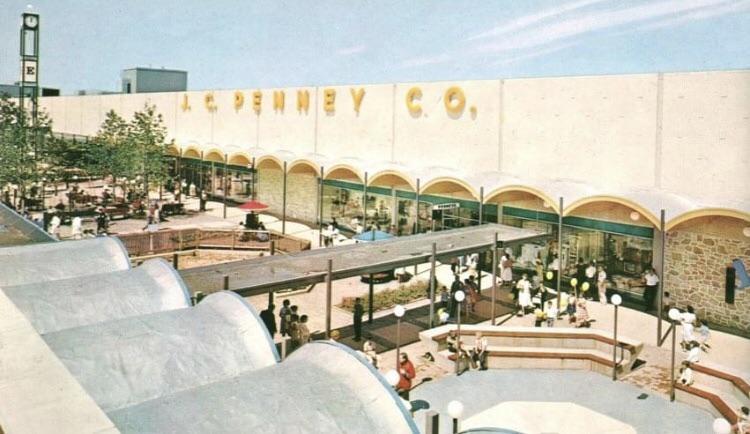
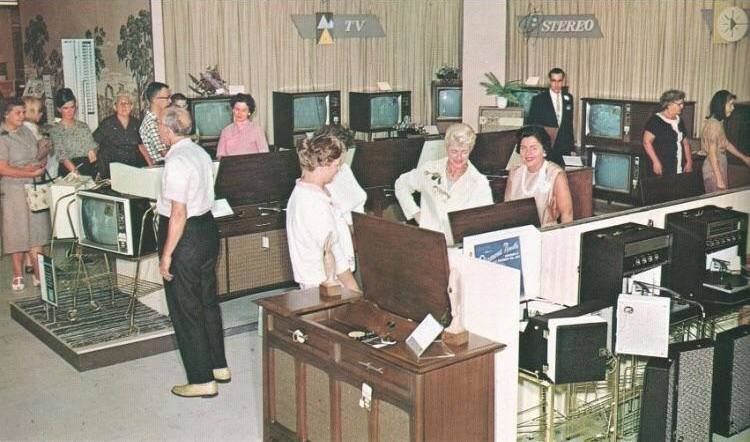
King of Prussia Plaza opened in 1963. J. C. Penny was one of the mall’s original anchor stores. | Photos: Reddit
As the Delaware Valley’s malls have been swept up in the e-commerce wave wiping out many malls across the country, Hildebrandt’s preservationist antennae have started to tingle. Just how perilous the moment is for malls is subject to debate. “U.S. malls are dying, and there may be just 150 left in 10 years,” blared a headline in Business Insider, while CNN Business claims “The U.S. Mall is not dying.” However, go shopping for statistics and the numbers seem to speak for themselves. In the 1980s, there were about 2,500 malls in the United States, according to Atlas Obscura, while the estimated number today ranges from about 750 to 1,150, which some analysts predict could drop to into the low hundreds by 2032.
Some of the discrepancy may come from exactly what constitutes a mall, a taxonomic challenge complicated by an era in which many malls are reinventing themselves, some closing for years before reopening as casinos, entertainment centers, with residential and commercial conversions, or with a mix of uses.
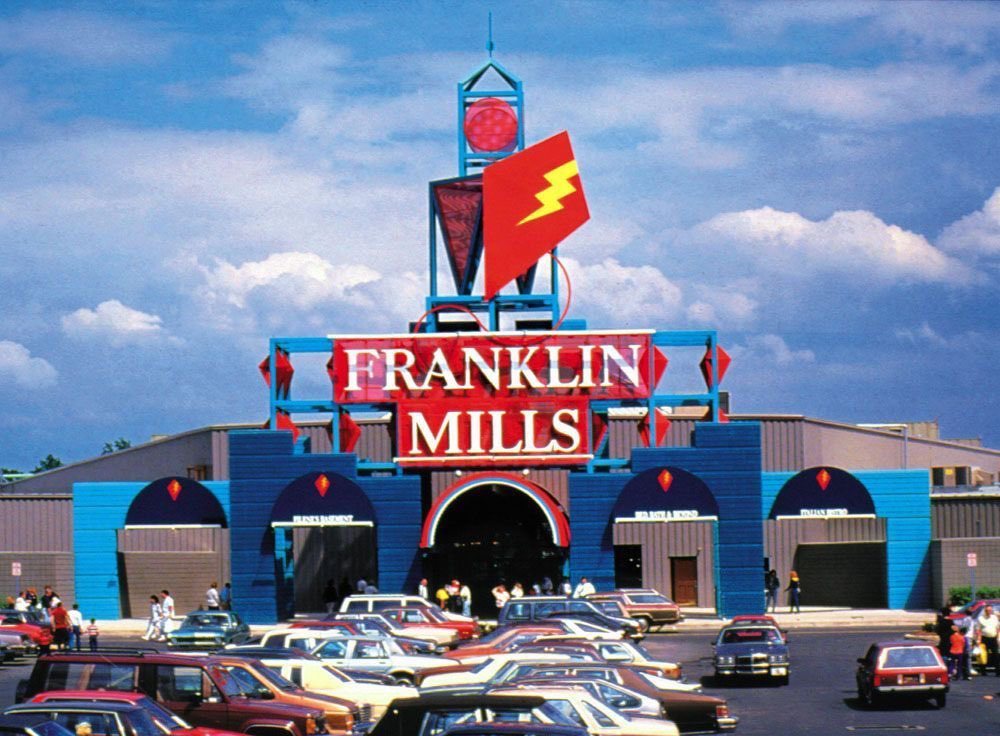
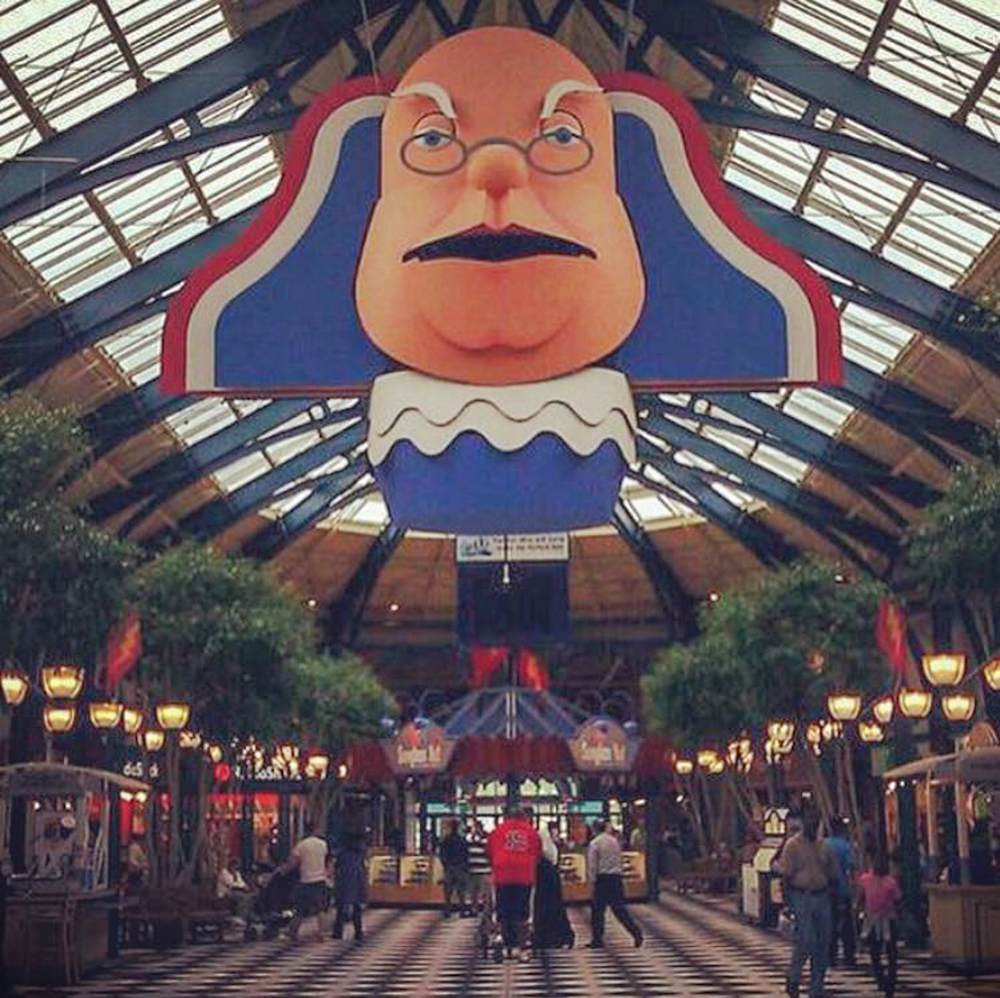
Franklin Mills in Northeast Philadelphia opened its doors in 1989. | Photos: Reddit
Even still, it begs a question for Hildebrandt: should anything be done to preserve some essence of the golden era of the American shopping mall? She admits it’s a challenging question. First, there are considerable logistical issues in attempting any kind of traditional, large-scale preservation effort of a mall. Furthermore, as she knows firsthand working for Sacred Places, there is already a mismatch between the number of high value targets for preservation and the resources to make it happen, without adding such a heavy lift to the list.
Yet, perhaps the most difficult hurdle to overcome is skepticism within the preservation community that shopping malls are worth honoring, especially given their role hollowing out urban centers and indeed imperiling buildings already denoted as historic (Exhibit A: Center City’s Wanamaker building). Still, Hildebrandt wonders. “My personal take is that the American mall is significant, but it was also so prolific, right? It’s like, how do we decide which were the significant ones? Which ones do we really want to invest in and keep? Which are we OK seeing close?” said Hildebrandt. “I most definitely think there are historic malls out there. Convincing the public at large that that is the case seems like an uphill battle.”
The Birth of the American Shopping Mall
Jeffrey Hardwick is public programs director for the National Endowment for the Humanities, one of the largest funders of important museums and historic sites across the country. So, the fact that he wrote a book on shopping malls, Mall Maker: Victor Gruen, Architect of an American Dream, may seem a little incongruent. Not so, Hardwick said, adding he thinks there is enough “there” there to add some malls to the lexicon of spaces in America worth protecting, or at least recognizing. “You know, Postmodernists looked to Las Vegas and the layout of casinos for their inspiration. There’s so much [conversation to be had around] popular architecture and its value. I do think preservationists end up fetishizing a little too much, you know, an 1800s Greek Revival thing with its balusters intact,” explained Hardwick. “That was one of the things I ran into doing the research.”

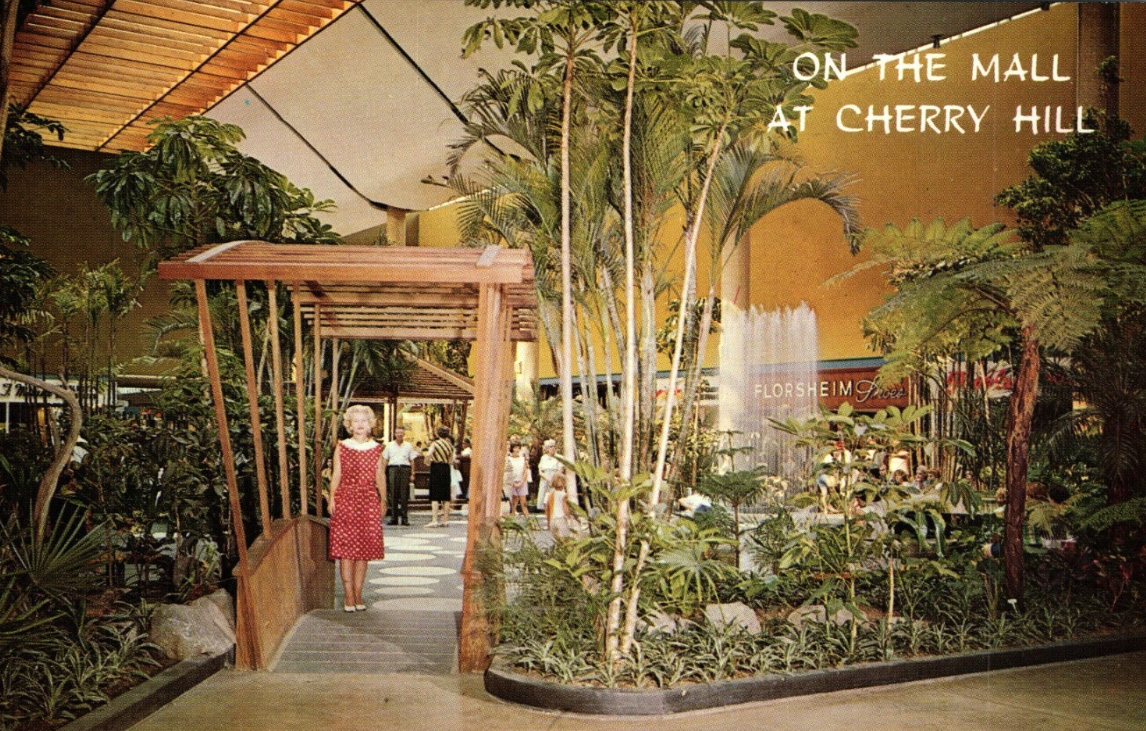
Cherry Hill Mall opened on October 11, 1961. It was designed by architect Victor Gruen and was the first large enclosed mall on the East Coast. | Images: Ebay
Hardwick acknowledges that malls have a problematic history. These were spaces built for a “99 percent white” clientele during the era of white flight and segregation, leading to major economic decline in urban areas and deep-seated sociodemographic problems that continue through today. “Critical aspects need to be taken into account,” he said, but also doesn’t believe them to be disqualifying.
Hardwick said early forms of the modern American mall began to arise in the 1930s and 1940s from a combination of factors. Suburbanization was underway and early experiments in commercial development there were waylaid by the Great Depression, leading to blighted buildings that were viewed as a drag on land values and the bucolic ideal of the suburbs. So post War World II, planners began zoning off specific parcels of land for commerce, then burying them behind treelines and topography so as not to upset the locals. “The shopping mall ends up strangely as this kind of planning idea that you’re going to put a giant commercial center in the middle of domestic suburbia. You’re going to hide it behind large mounds of soil. You’re not going to have signage or anything. You’re not going to see it from the road,” Hardwick said. “Then you bring in all of the retailing needs for a community.”
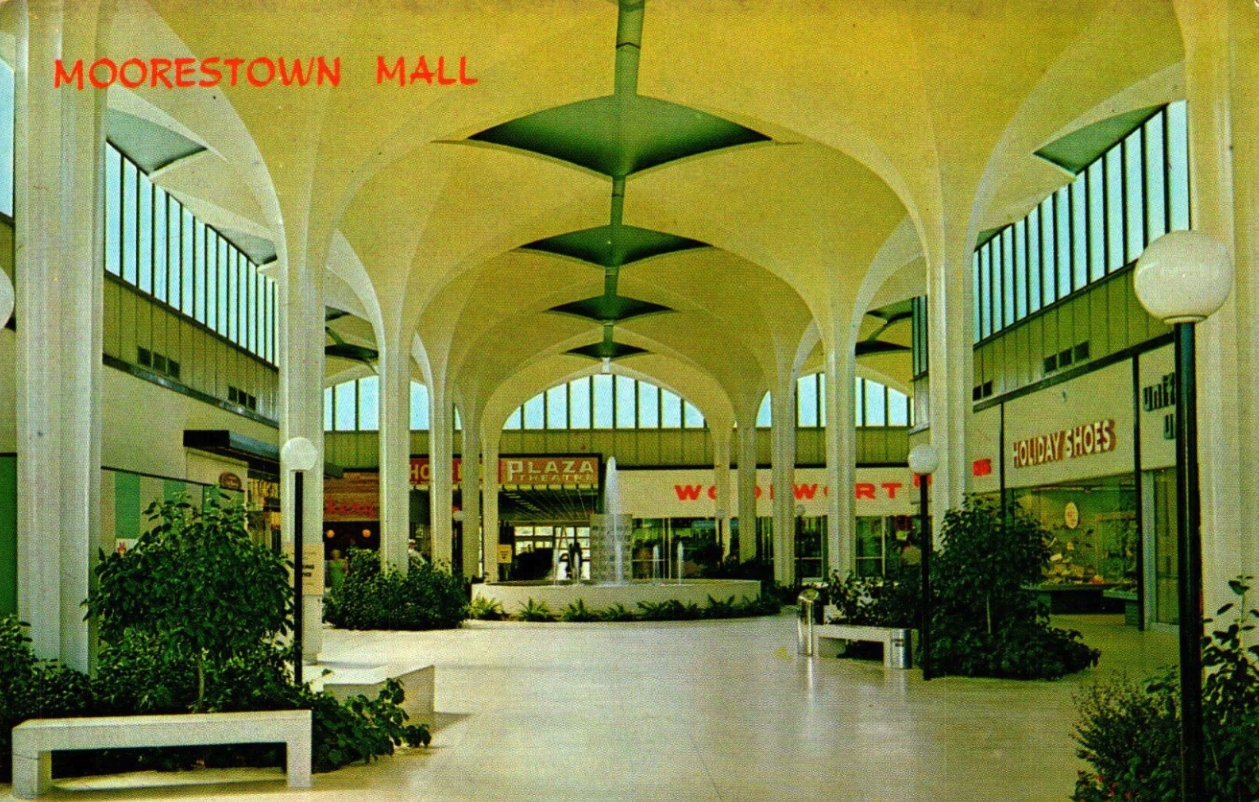
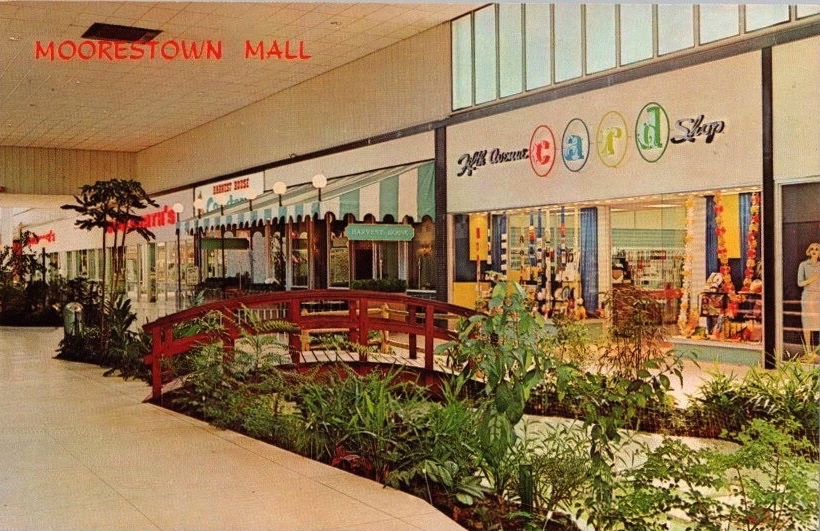
Moorestown Mall was built in 1963 and designed by John Graham Jr., the architect behind the Space Needle observation tower in Seattle. The mall has undergone a number of character-altering interior renovations beginning with a wide-scale redesign in the mid-1980s. | Images: Ebay
Enter Victor Gruen. A Jewish, Vienna-born architect, Gruen fled an occupying Nazi regime following Kristallnacht in 1938 and landed in New York City. A showman and prolific writer of books and essays, Gruen positioned himself as a leading visionary of the American shopping mall. He wasn’t the first to build a modern shopping mall, Hardwick said, but was certainly the most influential architect in the space. Of the dozens of malls he designed in the mid-20th century, the Southdale Mall in suburban Minneapolis is often referenced first as the country’s first fully enclosed shopping center, opening in 1956. Regionally, Gruen designed the Cherry Hill Mall.
“One of his big problems is financing, and he figures out a way to convince the department stores that they’re going to be the main developers of these shopping malls,” Hardwick said. “They don’t realize that once they put in the suburban shopping malls that they’re going to kill their downtown flagship.”
Economics aside, Gruen’s ethos and designs may be surprising to some. Openly Socialist for a time, Gruen had a certain egalitarian instinct, and in other corners of his career argued that downtowns should be people and not car-centered places. Indeed, his vision for the shopping mall was as a sort of “European town square in a soulless wasteland” of suburbia, Hardwick said. Design features often included fountains and gardens, and Gruen aimed for a diverse mix of tenants. “He imagines the shopping mall is going to be a mixed-use space, so it’s not going to be solely devoted to retail,” said Hardwick. “Libraries, a childcare center, a post office. You’re going to have office buildings and apartments. Some of that is actually at Cherry Hill.” While Hardwick said Gruen is sometimes criticized as an architect, he thinks Gruen is undeniably important historically, noting that modernist architect Philip Johnson applauded his work and called him the most influential architect of the era.
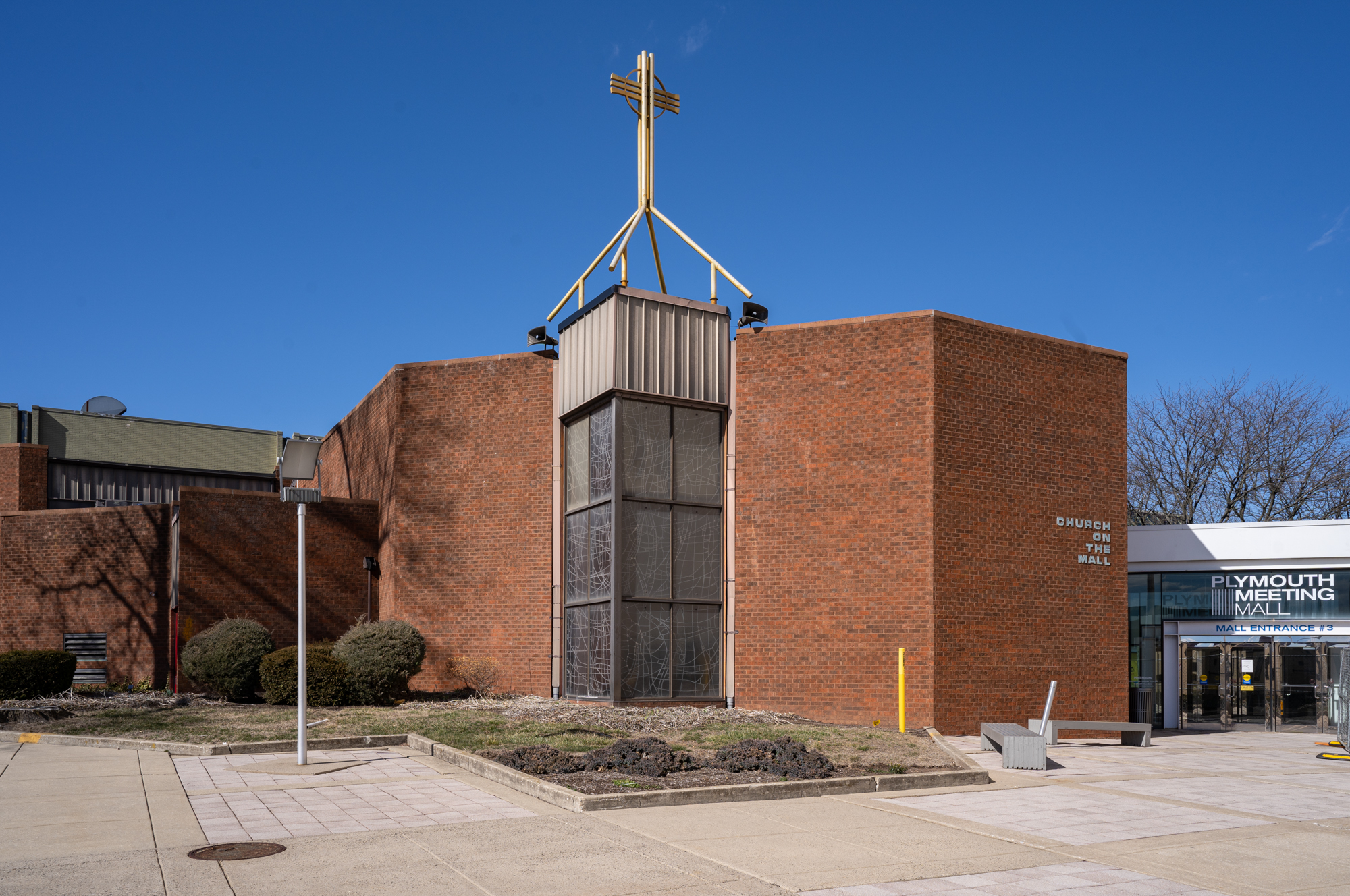
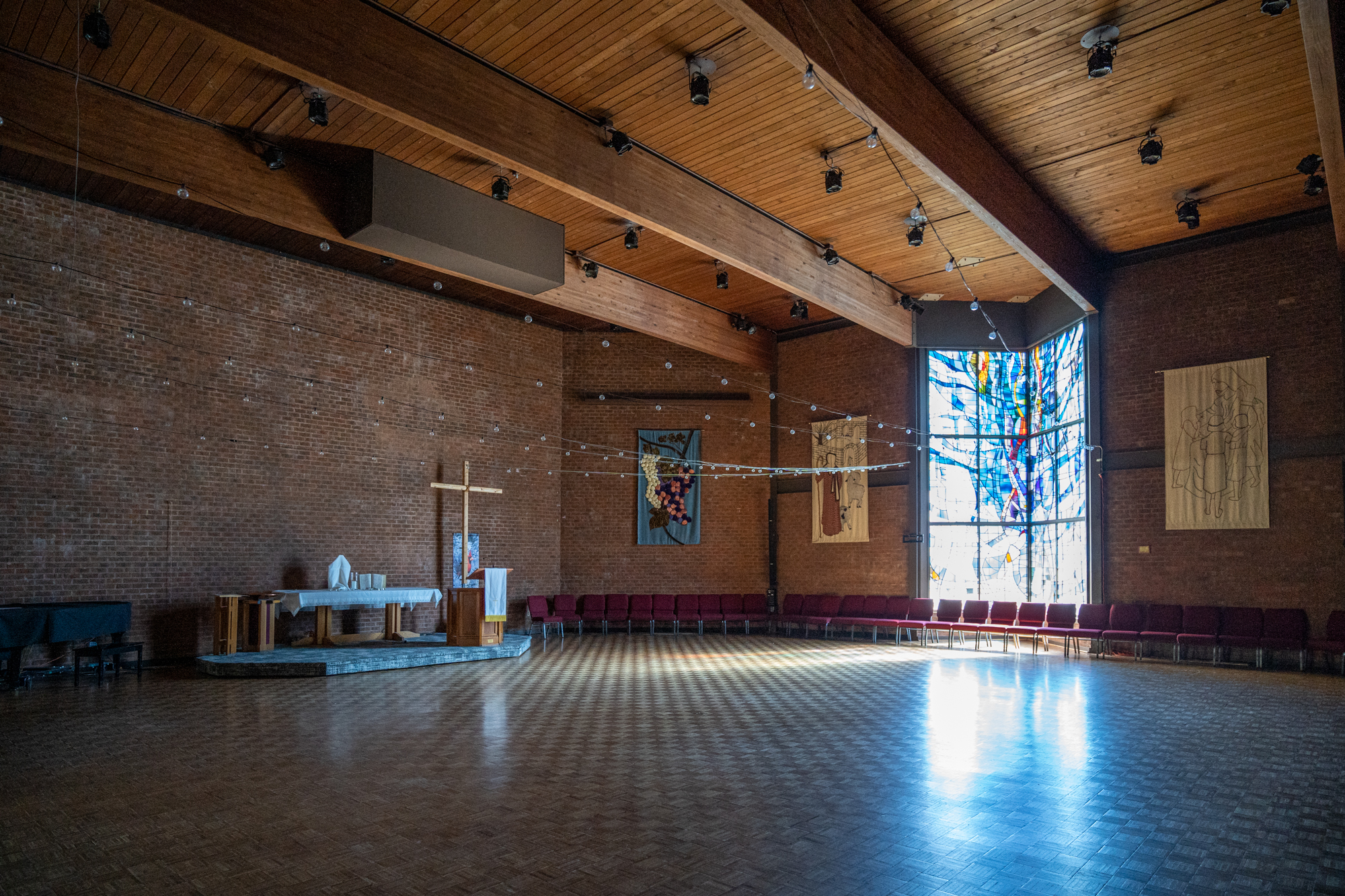
Church on the Mall at Plymouth Meeting Mall was established in 1966. The congregation, made up of three merged churches, worshiped in common spaces within the mall when it was closed on Sundays. Its permanent home was built in 1972. | Photos: Michael Bixler
Further complicating the image of the American shopping mall as a soulless monstrosity, Hardwick said, are “amazing” images of the Chicago Symphony Orchestra and Duke Ellington performing at malls in suburban Chicago, and court cases arguing that protests at malls should be protected by the First Amendment, given their station as the central public gathering point in suburban communities. “The mall does become a community focal point,” Hardwick explained.
Hildebrandt sees similar dynamics locally. One of the spaces she finds fascinating in the region is the Church on the Mall, a Presbyterian congregation that relocated to the Plymouth Meeting Mall in the 1960s and continues to worship there today, in a purpose-built space replete with stained glass windows and a faux-spire cross.
Hildebrandt said it was an intentional choice for the congregation to follow the flow of the American populace into a mall. As far as she knows, it was the first of its kind anywhere in the country. “It was about being where the people are, from a mission perspective,” she said. All of this leaves a lingering question of whether some part of our history would be lost should such a place slip into the past without recognition.
The Rise and Fall of Philly’s Malls
Hardwick’s history of malls can be traced in the Delaware Valley. In 1927, construction began on Ardmore’s Suburban Square, a campus of several buildings designed to include a variety of commercial and entertainment uses along with department stores. “Local residents were concerned about the traffic and the decline of property value,” noted the Lower Merion Historical Society in a history of the mall. “Ardmore business owners feared a drop in revenues, but building moved forward.”

A drawing of an early proposal for The Gallery on Market Street by architect Romaldo Giurgola. | Image courtesy of Mitchell/Giurgola Collection, The Architectural Archives, University of Pennsylvania
However, it is Gruen’s Cherry Hill Mall, opened in 1961, that has the claim of the area’s first modern, enclosed shopping mall–a claim also exists that it was the first east of the Mississippi River, but that butts up against similar claims such as Maryland’s now-demolished Harundale Mall, opened 1958. The King of Prussia Mall came next in 1963, Plymouth Meeting Mall in 1966, Oxford Valley Mall in 1973, Montgomery Mall in 1978, the Willow Grove Park Mall in 1982, and Franklin (Mills) Mall in 1989. Center City Philadelphia’s long-running struggle to compete began with the opening of The Gallery in 1977, now called Fashion District Philadelphia.
The health of all of these institutions varies. The Pennsylvania Real Estate Investment Trust (PREIT) owns Cherry Hill, Willow Grove, Plymouth Meeting, Exton Square, and Moorestown malls, but declined an interview. Mario Ventresca, chief financial officer for PREIT, did speak with WHYY in November 2024 and put forth generally good vibes, despite the company having filed for bankruptcy twice in the past five years. The station’s reporting noted that some malls, such as KOP and Cherry Hill, continue to attract both tenants and customers, while reinventing themselves with dining and entertainment experiences that can’t be purchased online, as well as adding residential and healthcare uses. Others, like Willow Grove and Exton, appeared to be falling short, with the latter in the process of being sold by PREIT to the Abrams Realty & Development company, WHYY reported.
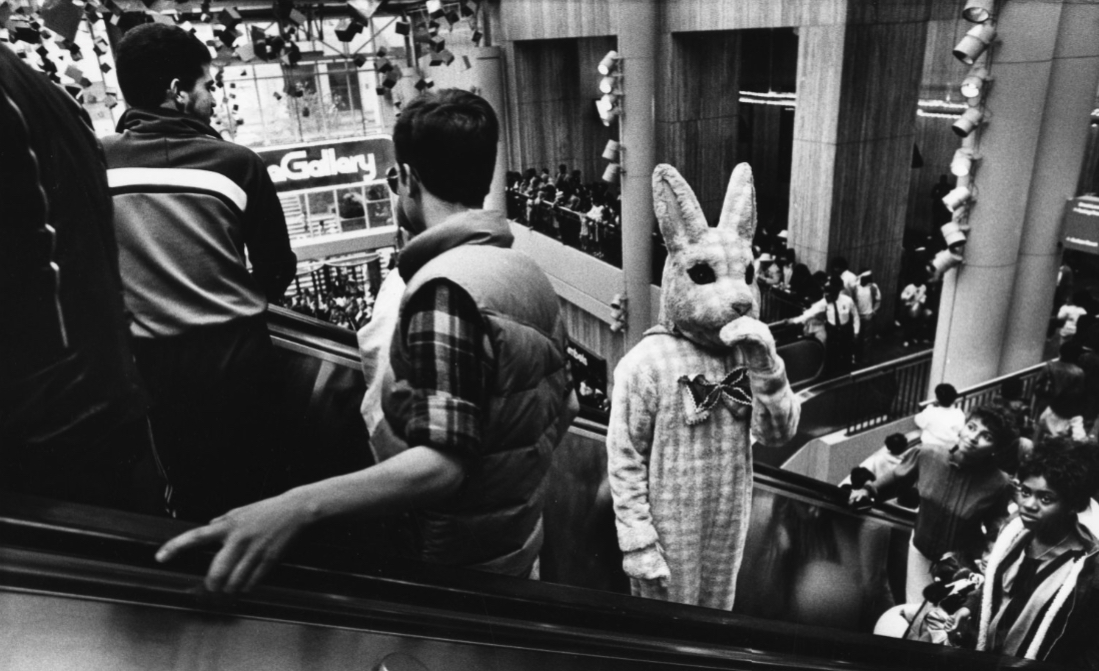
The Easter Bunny rides an escalator at The Gallery during its heyday in 1985. | Photo courtesy of Special Collections Research Center, Temple University Libraries
The malls within Philadelphia proper appear to be tipping toward that end of the spectrum. As of 2023, the Fashion District had a tenancy rate of 80 percent, tracking significantly below that of KOP, Cherry Hill, and even Willow Grove. About a third of its square footage was set to be demolished for the 76ers arena before the plug was pulled, leaving an open question of what happens next. Franklin Mall has undergone a series of name and ownership changes in recent years, most recently seeing a name change from Philadelphia Mills after private investment group Jones Lang LaSalle purchased it over the summer. The company has yet to reveal any further plans to try and reinvigorate the site.
This shifting nature of malls presents a challenge to any potential efforts to preserve or historically recognize them. As Hildebrandt pointed out, architectural integrity is often a valued trait in a preserved building, and malls inherently are constantly shapeshifting. “There aren’t a lot of malls out there that are preserved in amber,” she says.
Given that there’s no immediate signs of demolition for any area malls, Paul Steinke, executive director of the Preservation Alliance for Greater Philadelphia, doesn’t see much reason to act. “I don’t think there’s much of a clamor for preserving malls, but there is a new desire to find new uses for the real estate,” Steinke said. Looking at the bigger picture, Steinke also expressed some skepticism. He doesn’t see much love for the architecture of malls among preservationists, and while he understands there is a community of people devoted to remembering the golden era of the American mall, he cops to personally not being particularly enamored by them. “I wouldn’t care if Franklin Mall went away, but there are some people who might be devastated and speak out for preservation in some way,” opined Steinke

The old entrance of The Gallery at 9th and Market Streets readies for its reinvention as The Fashion District in 2017. | Photo: Michael Bixler
What would that look like? At the grandest scale, the first thought Steinke had was of the Smithsonian Museum of American Industrial History in Bethlehem, which is located on the site of a former Bethlehem Steel property, amongst its hulking, rusting stacks and dilapidated factory buildings. Yet, that appears to be without precedent. Hardwick said he is aware of some efforts to preserve the signage, layouts, and some buildings of smaller predecessors of the modern mall, but nothing approaching the full-scale preservation of a shuttered mall, especially the behemoths that dot the Delaware Valley.
Hildebrandt noted that there are already robust online communities dedicated to collecting memorabilia from malls that have been demolished or are heading that direction. Perhaps these groups might be the best thing we’ve got for commemorating the American shopping mall, whatever its value. “There are some unbelievable postcards out there of the Cherry Hill Mall when it opened,” Hildebrandt said. “Beautiful, beautiful. Like lush, with plants, very classic midcentury. But it doesn’t look like that anymore.”


You left out the Neshaminy Mall. I shopped there with my mother when I lived in Levittown and was a kid. Maybe late 60’s or early 70’s. Definitely before Oxford Valley Mall (which opened when I was in high school) by several years. Neshaminy Mall was the only mall for several years.
Hi Karen! It’s Jeff Yannello from Sandburg before I left the district! You are right about Neshaminy msll
No mention of the Cherry Hill Mall’s giant bird cage near Woolworth😂
I have so many memories of pure joy from my childhood that ALL in one of two places: Moorestown Mall or Cherry Hill Mall. I had no clue regarding their places in architectural history. Moorestown Mall had live duck families (male, 2 or 3 females, and their ducklings swimming in the ponds under the bridges seen in the photographs, we’re simply walking about the mall. There was never any danger of them being harmed or maimed; that sad obsession came from generations that followed mine. I am proud to be one of the last of the Boomers, and every time some smart mouth human 10 or 20 years younger sneers “whatever, Boomer”,I say thank you. They have no idea what they missed.And I am far from some uptight old man,tsk-tsking onabout “respect your Elders.” We were FERAL i mant ways, learned self-sufficiency because our parents werent hovering over our every move or doing our homework for us. And believe me, we had rules, and curfews and boundaries that were clearly definedand we did not DARE cross. My point being that we could be dropped off there at noon and picked up at five pm, and there was never any problem. ( AND ONLY ON RAINY OR SNOWY DAYS, JUST TO BE CLEAR!) My point being I haven’t been to either in a long time, but I’m gonna get down there ASAP from New York City if they are indeed going to be torn down.
GARYONBROADWAY
OK! Addendum! I should have checked it out firs, but I now know that Cherry Hill Mall HAS been demolished, but so I still have time to get to Moorestown Mall! Whew!
The Cherry Hill Mall has not been demolished. Only the office tower was taken down this summer(2025)
Gary,the Cherry Hill Mall in(route 38) New Jersey is still operating. It has been remodeled several times and newer stores have been added, but was never demoslised to my knowledge. Strawbridge & Clothier went out of business. Macy’s, JC Penny,boutiques and several restaurants are still there. Moorestown Mall also went through many changes. John Wanamaker went out of business,and they added a new structure for Lord &Taylor,which has since closed,as well as the Sears store.It certainly is not, shall I say like the Good Old Days, but lots of fun memories.
Gallery will go through a growing pang before they can invent what they are. Sixers may be looking for a site away from Gallery or they might be looking at the land available since 1979 when Gilpins was demolished in 1977.
We will see what happens later on.
Loved the Cherry Hill Mall. Use to go there all the time, it had a cocktail lounge I frequented!