

A block of well-maintained Victorian twins leads by example within the Powelton Village Historic District. | Photo: Michael Bixler
To date, there are 45 historic districts on the Philadelphia Register of Historic Places. While the first, the Main Street Manayunk Historic District, dates back to 1984, the majority of them have been created within the last decade.
Paul Steinke, executive director of the Preservation Alliance for Greater Philadelphia, believes there’s a reason for the increase. “In many cases, the nominations are put forth by neighbor associations that are concerned about development,” he noted. “The neighbors turn to the Historical Commission to help manage these changes.” Recent examples include the Powelton Village Historic District, nominated in 2022 by the Powelton Village Civic Association and the Victorian Roxborough Historic District, nominated that same year by the Central Roxborough Civic Association.
The extensive nomination process for a historic district requires a map of the proposed district’s boundaries, written descriptions and photographs of all its built and natural environments and characteristic streetscapes, an inventory of every property, a bibliography of the major references cited in the nomination, and a statement of significance that references at least one of the 10 criteria for designation as listed in Section 14-1004(1) of the Philadelphia Code, such as representing a significant era in the city’s history, or association with a significant architect or historic person. For a historic district nomination, the presentation can easily run to many hundreds of pages.
Designations, for either an individual property or a historic district, are occasionally contested, but the Philadelphia Historical Commission usually prevails. That is not surprising, given the exhaustive research that goes into a successful nomination and the Historical Commission’s multi-step review. In early March, however, a judge in the Court of Common Pleas overturned the 2024 designation of the Washington Square West Historic District in a lawsuit filed by three properties owners and subsequently joined by others.
The owners cited concerns that the designation would inflict burdensome expenses on them. “In general, I think the complaint about cost is not unfounded, but it is overblown,” said Steinke. “It’s not the case that some preservation police will force you to change your property to bring it up to some kind of historic standard.”
Judge Christopher Hall’s brief ruling stated the nomination “was not in accordance with law,” and that the decision to designate the district “was not supported by ‘substantial evidence.’” With over 1,000 properties in the district, the nomination for the Washington Square West Historic District unsurprisingly contained nearly 1,500 pages of documentation.
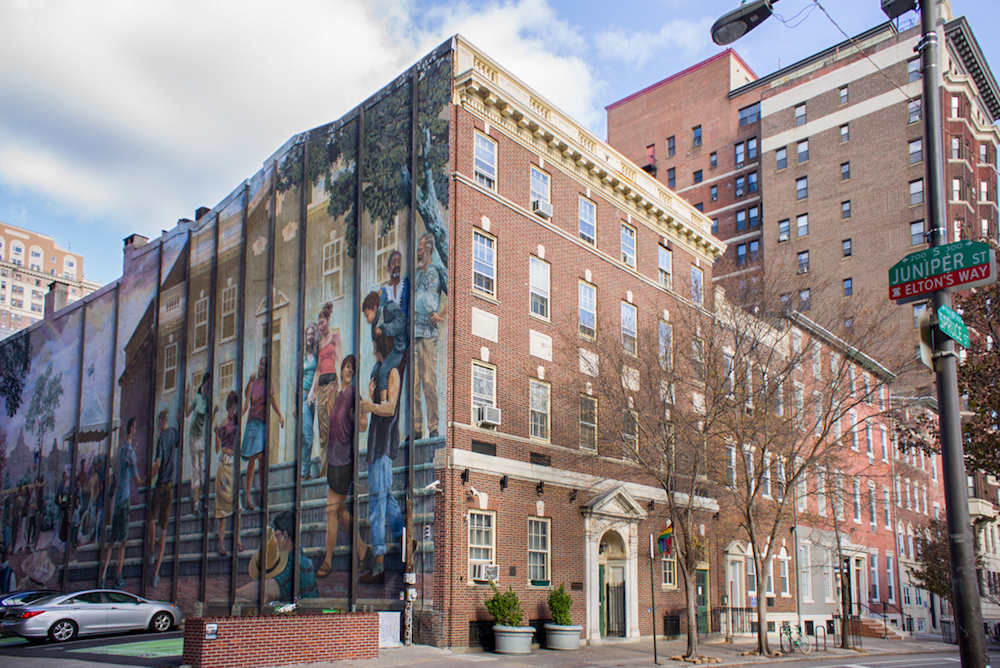
The leadership of the William Way LGBT Community Center recently announced that the organization will demolish its longtime home at 1315-1317 Spruce Street for new construction. Public outcry has ensued. The historic building sits within the legally-protected Washington Square West Historic District, a designation currently embroiled in litigation. | Photo: Michael Bixler
At the time of the designation, the nominators had argued, and the Historical Commission had agreed, that the district satisfied six of the criteria for designation, as it is representative of the development and heritage of the city, features several distinctive architectural styles by significant architects, and in addition to the built features, may yield archaeological history. More than half of the properties in the district had already been individually designated.
“What underlies the judge’s decision is something of a mystery. It seemed like the judge was treating it like a judicial proceeding,” said Steinke. “The Historical Commission is an executive function. They’re not judicial, and because of that, they’re not set up as a court.”
The City’s Law Department appealed the decision to the Commonwealth Court, which restored the designation during the appeal. At the same time, the Preservation Alliance, which did not participate in the first set of hearings, petitioned the Court of Common Pleas to reconsider the appeal with the Preservation Alliance treated as an appellee.
On March 30, 2026, the court granted the petition and vacated its order. It granted appellee status to the Preservation Alliance and the Washington Square West Civic Association, the co-nominators, directing all the parties to file new briefs. While a hearing for new oral arguments has not yet been scheduled, the district remains under the jurisdiction of the Historical Commission until the court’s review and ruling.
That protection will extend to the building at 1315-17 Spruce Street, the former Engineers Club, classified as “significant” to the Washington West Historic District. Its current owner and occupant, the William Way LGBT Community Center, has announced its plan to demolish the 1917 building and replace it with a six-story facility to include affordable senior housing on the upper floors.
Meanwhile, lawsuits are also pending against two other historic districts.
An appeal of the designation of the Southeast Spruce Hill Historic District in West Philadelphia was filed by several property owners and denied by the Court of Common Pleas in December 2025. The appellant has appealed the denial to the Commonwealth Court.

Cresheim Valley Apartments at 7200-04 Cresheim Road were built in 1914 and designed by Henry DeHoff. The complex is listed as contributing to the Northwest Philadelphia Apartment Thematic Historic District. An individual property owner is currently challenging the legality of the entire district. | Photo: Michael Bixler
Designated in January 2025, the Northwest Philadelphia Apartment Thematic Historic District comprises 30 apartment buildings along the Chestnut Hill West Regional Rail Line in Germantown and Mt. Airy. The nomination proposed, and the Historical Commission agreed, that collectively the buildings, constructed between 1910 and 1940 with suburban-like features such as lawns and landscaped courtyards, transformed the area into a suburban-like, middle class enclave. During the Commission’s review of the nomination, the owner of one of the properties had asked to be removed from the district’s inventory. When that request was denied, they then filed an appeal of the entire designation to the Court of Common Pleas. Oral arguments are to be held after June 5.
Recently, there has been an uptick in proposed historic districts, with six potential nominations currently at various stages, including four—Tulpehocken, Wissahickon, Yorktown, and Pelham in the Northwest, one in East Falls, and a Chestnut Street West Historic District in Center City. How the Washington Square West ruling will affect these nominations is not clear, but Steinke is optimistic about the Preservation Alliance’s nomination for Tulpehocken. “The circumstances are different, and the neighborhoods are different,” he explained.
While possible cost concerns are frequently a reason for appeals of designated properties, another pushback comes from an impression that historic preservation somehow hinders the housing development needs of many cities, including Philadelphia. “I feel like preservation is under the gun today, everywhere,” noted Peg Breen, president of New York Landmarks Conservancy, a non-profit organization dedicated to preserving New York City’s architectural heritage through financial and technical support and advocacy. “There is enormous pressure for housing and there’s a perception that preservation gets in the way.” She sees that misunderstanding coming from the public and office holders alike, referring to a statement put out by Brooklyn Borough president Antonio Reynoso that he would not support the creation of any more historic districts.
Preservationists believe the numbers don’t support that view. For example, New York City has around 157 historic districts, ranging in size from a couple of blocks up to very large neighborhoods. Despite that seemingly big number, Breen pointed out, “Altogether, our historic districts take up about five percent of the city’s land area.” Similarly, the Philadelphia Register of Historic Places represents 4.4 percent of all buildings in the city.
Locally, the Preservation Alliance issued a report last year, Growing Through Preservation: The Economic Impact of Historic Preservation in Philadelphia, demonstrating that in the past decade, rather than hindering the creation of housing, the number of housing units in historic districts actually increased at more than twice the rate of the rest of the city.
The authority to designate historic districts was added to the City’s historic preservation ordinance in the early 1980s. When it was created in 1955, the Historical Commission’s power was limited to the designation of individual properties. “Preservationists felt that wasn’t sufficient to preserve streetscapes,” recalled David Brownlee, who served on the Historical Commission for many years beginning in the 1980s. Since then, historic districts have become an important tool to preserve the distinguishing character of neighborhoods.


Outstanding article!!!