
On July 11, the Pennsylvania General Assembly passed its 2024-2025 budget. It was 11 days past the deadline, but offered some good news for historic preservationists and adaptive reuse developers. The new budget included tax code changes that raised the historic tax credit program to $20 million from its previous cap of $5 million.
Most states offer a tax credit on projects that rehabilitate historic properties. Pennsylvania’s program was established in 2012, allocating $3 million a year with a per-project cap of $500,000 or 25 percent of qualifying expenses. Seven years later, it was increased to $5 million, where it has stood until now.
On average, the credit supports roughly 15 projects per year, about half of the applications submitted, with many receiving less than the maximum $500,000. In Philadelphia, one only needs to look around to see the large stock of historic buildings and the amount of development in the city to see that the potential use could be much greater.
“Developers have told us they stopped applying because it was such a small amount of money relative to the overall cost of a project, and with the process being so uncertain,” said Mindy Crawford, executive director of Preservation Pennsylvania, a nonprofit organization that champions the preservation of historic buildings and structures throughout the Commonwealth.
Last October, the Preservation Alliance for Greater Philadelphia and Preservation Pennsylvania hosted a symposium in West Chester to launch a drive to increase the historic tax credit. Representatives from Pennsylvania’s surrounding states explained their programs, all of which were more generous, ranging from tiny Delaware with $8 million to New York and West Virginia with no cap at all.
“We identified it as a priority to increase the number of properties repurposed or rehabilitated,” explained Paul Steinke, executive director of the Preservation Alliance, which, along with Preservation Pennsylvania, mobilized to build a broad coalition of preservationists, architects, developers, business associations, and historians to lobby for the increase. “We argued that adaptive reuse of historic buildings returns more jobs than any other investment in the state, and Pennsylvania has been missing out.”
They found a supporter in State Senator Nikil Saval (D-Philadelphia), who joined with his co-chair on the Urban Affairs & Housing Committee, State Senator Frank Farry (R-Bucks) to co-sponsor the bill. The PA Historic Tax Credit Coalition formed by Steinke’s and Crawford’s organizations successfully lobbied their representatives in both chambers, and the issue made it into this year’s budgetary process.
With demands always exceeding available funding in the state budget, the program’s structure as a credit rather than an appropriation helped it gain support. “We’re not allocating money, just knocking a little off the revenue side,” Farry pointed out. “Then, on the business side of the ledger, there’s the opportunity to get that revenue back, and more, with tax-paying construction jobs and tax-paying tenants.”
“It’s significant progress,” noted Saval. “We’ll start to resemble other states in what they allocate.” He went on to note that, despite the bill’s origination in the Urban Affairs Committee, the tax credits are distributed throughout the state. “In rural areas, where there is less development pressure, tax credits can be an incentive to make projects feasible.”
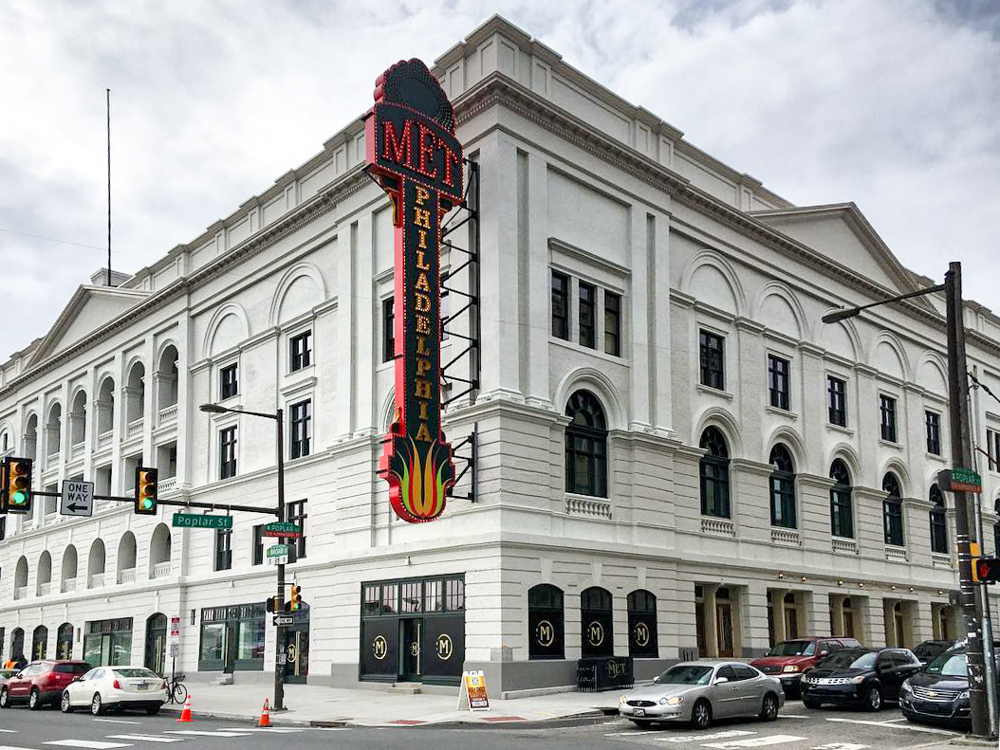
The former Metropolitan Opera House at 558 N. Broad Street was restored and reactivated in December 2018 after decades of deterioration. The developers, Eric Blumenfeld and Holy Ghost Headquarters in partnership with Live Nation, used historic tax credits to help fund the $56 million project. | Photo: Michael Bixler
Advocates are now turning their attention to a few more issues they say need to be resolved to really improve the program. They’re calling for an increase in the per-project cap from the current $500,000 to $2.5 million. According to Crawford, that larger amount is fairly typical of other states’ programs. Also, they’re seeking to change a current restriction from the Department of Revenue that bars projects with a nonprofit partner.
“We’re going back to the legislative leadership and explain why they’re needed,” said Crawford. “We’d like to get a bill passed now rather than waiting until next year.”
Also on the coalition’s to-do list is to keep legislators apprised of the increase’s effect, and to continue to press for something closer to their original goal of $50 million. “While I want to show the impact of going from $5 to $20 million, I still want to extrapolate what we could do if we were funded like other states,” said Crawford.
Saval hopes the increased funding will make reuse projects more prominent in their communities and demonstrate their value to other societal concerns, like housing availability and sustainability. “A lot of times we do things that a small percentage of the population care about, but in fact have far-reaching effects,” said Farry. “The preservation part is important, but it also helps the housing crisis.”
“Historic preservation at its heart has a social mission,” said Saval. “It’s deeply felt by Pennsylvanians when an unused or underused building is brought into new use. It can be an economic driver in a community.”
“Even if you’re not interested in the preservation field, anyone can see the value of getting a building back into productive use and on the tax rolls,” agreed Steinke. “It’s about the health of our communities.”


Hi Kimberly,
I am a board member with Pasadena Heritage. I would love to talk to you about this article. Could we set up a video call?